
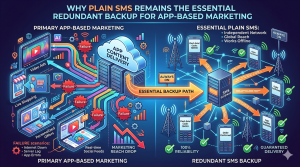
In today’s digital ecosystem, app-based marketing has become the center of customer engagement. Brands rely on push notifications, in-app messages, and automated workflows to communicate with users. However, despite this sophistication, systems can fail—apps crash, notifications are blocked, and users disable permissions. As a result, businesses are rediscovering the importance of plain SMS as a reliable backup layer in their SMS marketing strategy.
Moreover, customer attention is fragmented across multiple platforms. While apps offer rich experiences, they also depend heavily on internet connectivity and user settings. Therefore, when anything breaks in that chain, communication stops immediately. In contrast, SMS continues to function independently, making it a critical redundancy layer.
At the same time, businesses are no longer viewing SMS as outdated. Instead, they are integrating it strategically alongside app ecosystems. Consequently, SMS marketing is evolving into a fail-safe communication channel that ensures messages are delivered even when digital infrastructure fails.
Why App-Based Marketing Alone Is Not Enough
Although app-based marketing is powerful, it is also fragile. Users can disable notifications, uninstall apps, or simply ignore alerts. Therefore, relying solely on apps creates gaps in communication that can directly impact conversions and customer experience.
Additionally, technical issues such as server downtime or OS restrictions can interrupt message delivery. As a result, businesses may lose critical engagement opportunities without even realizing it.
In other words, app-based systems are effective—but not infallible.
The Reliability Advantage of Plain SMS
Plain SMS does not depend on internet connectivity, app installations, or platform permissions. Instead, it operates through carrier networks, which makes it one of the most resilient communication methods available. Therefore, it serves as a natural backup when digital channels fail.
Furthermore, SMS messages are typically delivered within seconds and have extremely high open rates. As a result, they ensure that critical information still reaches users regardless of app performance.
- Works without internet connection or mobile apps
- Delivers messages even when push notifications fail
- Maintains high open and read rates across all devices
- Bypasses app permission restrictions
- Ensures continuity during system outages or downtime
Because of this, SMS remains a dependable fallback mechanism in modern communication systems.
How Plain SMS Complements App-Based Marketing
Rather than replacing app-based marketing, SMS enhances it. When used together, both channels create a layered communication strategy that improves reliability and reach. Therefore, businesses can ensure that no message is missed.
Additionally, SMS can be used strategically for high-priority alerts, while apps handle richer, more detailed interactions. As a result, each channel plays a distinct and valuable role.
- SMS handles urgent alerts when apps fail
- Apps deliver rich content and interactive experiences
- SMS re-engages users who are inactive in the app
- Both channels reinforce each other’s messaging
- Redundancy improves overall campaign reliability
Consequently, combining both channels creates a more resilient communication system.
The Role of Plain SMS in Business Continuity
In critical situations, communication delays can lead to lost revenue or customer dissatisfaction. Therefore, SMS plays a key role in ensuring business continuity during unexpected disruptions.
Moreover, industries such as e-commerce, logistics, finance, and healthcare rely heavily on timely updates. As a result, having SMS as a backup channel is not just useful—it is essential.
- Order and delivery updates during app outages
- Security alerts and verification codes
- Service disruption notifications
- Appointment and schedule reminders
- Emergency communication during system failures
Because of this, SMS becomes a safeguard for uninterrupted customer communication.
Why SMS Marketing Still Matters in a Modern Stack
Despite the rise of advanced marketing technologies, SMS marketing continues to hold a unique position. Unlike other channels, it does not depend on complex infrastructure or third-party platforms. Therefore, it remains stable even in unpredictable environments.
Additionally, its simplicity is its strength. Messages are direct, clear, and instantly visible. As a result, SMS continues to outperform many newer channels in terms of immediacy and reliability.
- Independent from app ecosystems and platforms
- High deliverability regardless of device type
- Minimal technical dependencies
- Instant visibility to end users
- Consistent performance across regions and networks
Consequently, SMS marketing remains a foundational layer in modern communication strategies.
Common Mistakes Businesses Make
Even though SMS is highly reliable, some businesses underutilize it or treat it as secondary. However, this often leads to communication gaps when app systems fail. Therefore, proper integration is critical.
Furthermore, failing to define clear roles between SMS and app messaging can result in confusion and inefficiency.
- Using SMS only for promotional messages
- Ignoring SMS as a fallback system
- Overloading apps without redundancy planning
- Failing to synchronize messaging across channels
- Not testing SMS fallback scenarios
By addressing these issues, businesses can strengthen their communication resilience.
Frequently Asked Questions
Why is SMS still needed if we have app notifications?
Because SMS works independently of apps and internet access, ensuring messages are still delivered when apps fail.
Is SMS marketing still relevant today?
Yes, it remains highly relevant as a reliable, high-delivery communication channel and essential backup system.
How does SMS improve app-based marketing?
It adds redundancy, ensuring that critical messages reach users even when app systems are unavailable.
Plain SMS Reliance
Plain SMS remains one of the most reliable communication channels available today. While app-based marketing offers advanced features and rich interactions, it is not immune to failures. Therefore, SMS acts as a critical backup layer that ensures continuity and reliability.
Moreover, integrating SMS marketing into a broader communication strategy creates a more resilient system. Instead of relying on a single channel, businesses can ensure that messages are always delivered, regardless of technical conditions.
Ultimately, the strength of modern marketing lies not in choosing between channels, but in combining them effectively. When SMS and app-based systems work together, businesses achieve both sophistication and reliability—two essential ingredients for long-term success.
