
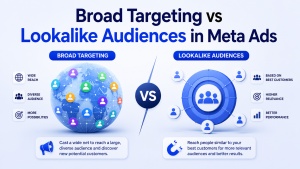
How do algorithmic prospecting methods compare when scaling commercial budgets? Maximizing paid return on investment relies on choosing between pure algorithmic freedom and structured seed-data replication. Because modern machine-learning models optimize delivery based on real-time behavior, old manual filtering methods have lost their efficiency. Consequently, deploying broad campaign structures in Meta ads utilizes the system's full scaling power to deliver the lowest acquisition costs, whereas utilizing lookalike pools allows you to mirror your customer targeting with surgical precision.
The New Era of Algorithmic Media Buying
For many years, digital advertisers spent hours adjusting granular interest parameters to find their ideal customers. However, in the current digital ecosystem of 2026, those restrictive setups often lead to high costs and limited reach. Because user privacy regulations have severely limited cross-app tracking, manual audience selection is no longer the most effective approach.
Fortunately, the evolution of automated targeting in Meta ads has shifted the heavy lifting to sophisticated machine-learning models. Today, success depends on feeding clean data to the algorithm rather than trying to outsmart the system with complex rules. Therefore, you must master the core differences between broad and lookalike approaches to allocate your budget effectively.
The Unmatched Scalability of Broad Campaign Frameworks
When you run a broad campaign, you deliberately strip away all interest, behavioral, and demographic restrictions. Instead, you define only your absolute geographic boundaries and minimum age requirements, leaving the remaining decisions to the AI.
Consequently, this open approach to targeting in Meta ads grants the system maximum optimization headroom to locate likely buyers across the entire network. Because the system is not forced to bid inside small, competitive audience segments, your cost per thousand impressions drops significantly. Thus, utilizing broad delivery models represents the absolute best way to scale high-volume e-commerce storefronts predictably.
- Lowest Unit Costs: Broad campaigns consistently deliver lower CPMs because they face less competition in the general auction.
- Creative as Targeting: The algorithm reads your ad visuals and copy to identify and self-select the perfect audience.
- Infinite Scaling Room: Because there are no arbitrary audience limits, your campaign can spend higher budgets without experiencing rapid performance fatigue.
The Surgical Precision of High-Value Lookalike Pools
On the other hand, lookalike strategies rely on replicating the specific characteristics of your existing customer base. Instead of starting from scratch, you provide the platform with a high-quality "seed" list of your actual purchasers.
Subsequently, the system analyzes millions of behavioral data points to locate new prospects who closely match your source list. This method of targeting in Meta ads is exceptionally valuable for businesses with niche products or longer sales cycles. Consequently, utilizing lookalikes ensures that your message lands in front of high-intent users even if your pixel conversion history is relatively new.
- Seed Quality Focus: Utilizing lists of repeat buyers or top-tier lifetime value customers generates the strongest lookalike signals.
- SaaS and Lead Gen Power: This approach excels at finding specific, hard-to-reach professional demographics in specialized industries.
- Proximity Percentage Controls: You can adjust your similarity settings from 1% for maximum precision to 10% for broader reach.
Strategic Comparison: Broad vs. Lookalikes
| Feature | Broad Targeting | Lookalike Audiences (1-3%) |
|---|---|---|
| Primary Advantage | Maximum scalability and lowest CPMs | Fast conversion optimization and high precision |
| Data Requirements | Requires high weekly conversion volume (50+) | Requires a high-quality seed list of 100+ customers |
| Best Industry Fit | E-commerce, retail, mass-appeal products | SaaS, B2B, specialized services, niche retail |
| CPA Efficiency | Highly efficient over long, scaled budgets | Highly efficient in early testing or low-volume states |
5 Critical Steps to Configure and Balance Your Prospecting Funnel
To build a highly resilient, modern advertising structure that leverages both strategies without creating internal competition, your team should execute a standardized playbook. Here is the exact roadmap to organize your campaign structure:
- Establish Pristine First-Party Data Feeds First: First, deploy both your standard browser pixel and the Conversions API to feed clean signals to your account. This complete data foundation ensures that the optimization algorithms have accurate purchase patterns to learn from.
- Launch a Broad Campaign for Mass-Appeal Items: Next, set up an Advantage+ Shopping or manual broad campaign for your main product catalog. By doing this, you allow the algorithm to freely locate cheap conversion opportunities across the entire platform.
- Build a High-Value Lookalike Seed List: Subsequently, export a custom list of your top 10% highest-value lifetime customers or repeat purchasers. This highly specific, high-intent source data forms the perfect foundation for a powerful 1% lookalike audience.
- Isolate Lookalikes in Niche Prospecting Ad Sets: Furthermore, deploy your lookalike audiences inside separate ad sets when launching specialized items or B2B offers. This tactical separation ensures you maintain strict guardrails when marketing to highly specific customer profiles.
- Monitor Audience Overlap Metrics Weekly: Finally, utilize the system's audience overlap tool to keep internal auction competition below 30%. Afterward, your campaigns will run smoothly without driving up your cost per click through bidding against yourself.
Creative Testing: The True Differentiator in Modern Targeting
Ultimately, the performance gap between these two methodologies is decided entirely by the quality of your visual creatives. Because automated targeting in Meta ads relies heavily on user interaction, your ad creative literally acts as your primary targeting filter.
Therefore, you should continuously run diverse visual hooks, layout styles, and copy angles across all active ad sets. When you feed the system multiple distinct creative directions, the AI can naturally match separate assets to different viewer segments. Fortunately, maintaining this active testing cycle keeps your campaigns running efficiently and drives consistent business growth.
Conclusion: Crafting a Balanced Hybrid Acquisition Engine
In summary, mastering modern digital acquisition requires moving past old debates to build a balanced, hybrid media plan. Because the platform's machine-learning systems are incredibly powerful, choosing between broad and lookalike strategies depends on your current data strength and product type. Fortunately, by combining the mass-market scaling power of broad targeting with the surgical precision of lookalikes, you can cover all stages of your customer funnel. Implement this integrated structure today to protect your marketing capital, optimize your delivery paths, and scale your business predictably.
Frequently Asked Questions (FAQ)
What is the ideal seed audience size for building a reliable Meta lookalike?
A reliable lookalike audience should ideally be built from a high-quality seed list containing at least 500 to 1,000 of your best actual customers.
Why are broad campaigns often more cost-effective than lookalike audiences?
Broad campaigns are more cost-effective because they give the algorithm maximum freedom, which lowers auction competition and decreases your overall CPMs.
Should you exclude existing customers from your broad prospecting campaigns?
Yes, you should always exclude your active customer list from prospecting campaigns to ensure your budget is spent entirely on finding new buyers.
