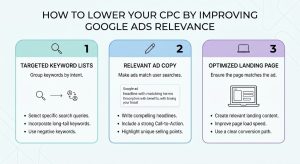
Google Ads relevance is the most critical quality factor to lower your cost per click across search campaigns. When you align your keywords, ad text, and landing page content, Google rewards your account with higher
Quality Scores. Consequently, your advertising costs decrease while your ad positions and conversion rates improve.
Why Keyword and Ad Alignment Matters
Google wants to show users the most helpful results possible. Therefore, the search platform rewards advertisers who deliver high Google Ads relevance through specific solutions. When a user searches for a service, your ad must address that exact query using high-intent keyword strategies.
In addition, strong alignment improves your overall Quality Score. For technical guidelines on how Quality Score is calculated, you can review the Official Google Quality Score Guide. As a result, campaigns with high Google Ads relevance ratings pay substantially less for top ad placements.
Core Pillars of the Quality Score Formula
Google calculates your overall account efficiency using three main components. Understanding these pillars allows you to diagnose weak campaigns quickly:
- Expected Click-Through Rate (eCTR): Google estimates how likely users are to click your ad when it appears in search results.
- Ad Relevance: This metric measures how closely your ad copy matches the intent behind a user's specific search query.
- Landing Page Experience: Google assesses how helpful, fast, transparent, and mobile-friendly your landing page is to visitors after they click.
Practical Steps to Boost Quality Score
Improving your performance requires a systematic approach. First, you must organize your account structure logically. Next, refine your messaging so users find exactly what they expect.
- Create tightly themed ad groups: Group closely related keywords together instead of using broad lists.
- Write targeted ad copy: Include your target keyphrase directly in your headlines and descriptions.
- Match landing page content: Ensure your landing page reflects the exact promise made in your ad text.
- Use negative keywords regularly: Filter out irrelevant searches to protect your click-through rates.
- Add relevant ad extensions: Include sitelinks and callouts to provide extra context to searchers.
For example, a local retail business targeting shoppers in Beirut should not send traffic to a generic homepage. Instead, direct users to a dedicated page that matches their search intent. Consequently, users stay longer on your website and convert faster.
Conclusion
Lowering your ad costs does not require cutting your overall budget. Instead, focus on building strong
Google Ads relevance across every campaign layer. When you connect search intent directly to your landing pages, you lower your CPC and boost sales simultaneously. Start auditing your account structure today to eliminate wasted spend.
Frequently Asked Questions
How does Google Ads relevance affect my cost per click?
Google evaluates how well your ad matches search intent. Higher relevance increases your Quality Score, which directly lowers the cost you pay for every click.
What is the fastest way to improve ad relevance?
Organize your keywords into smaller, tightly themed ad groups. Then, write specific ad copy that directly uses those exact keywords in the headline.
Does landing page quality impact my ad score?
Yes, Google scans your landing page text. If your landing page content matches your ad offer closely, your overall Quality Score increases significantly.