
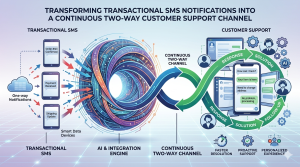
For a long time, transactional SMS messages were treated as simple one-way alerts. Businesses would send order confirmations, delivery updates, or payment notices, and that was the end of the interaction. However, customer expectations have changed significantly. As a result, companies are now rethinking how SMS marketing can extend beyond notifications into ongoing conversations. Moreover, customers no longer want to switch channels just to ask a simple question. Instead, they expect instant responses within the same thread where they received the update. Therefore, transactional SMS notif is evolving into a two-way communication channel that supports real-time customer service.
At the same time, this shift is not just about convenience. It is also about efficiency. Consequently, businesses that transform notifications into interactive support systems are reducing pressure on call centers while improving customer satisfaction.
Why Transactional SMS Is No Longer One-Way
Transactional messages already have high engagement rates because customers expect them. However, stopping the interaction after delivery creates a missed opportunity. Therefore, allowing customers to reply directly turns a basic notification into a support entry point.
Additionally, this approach aligns with modern communication habits. People are used to messaging apps where conversations continue naturally. As a result, SMS marketing strategies that adopt two-way communication feel more intuitive to users.
In other words, transactional SMS is becoming a gateway to real-time support rather than a final message.
How Two-Way Transactional SMS Support Works
Two-way SMS support allows customers to respond directly to transactional messages and receive automated or human replies. Moreover, these systems can be integrated with customer service platforms to route inquiries efficiently.
Furthermore, automation can handle common questions while complex issues are escalated to support agents. Consequently, businesses can maintain speed without sacrificing quality.
- Customers reply directly to transactional SMS messages
- Automated responses handle frequently asked questions
- Support tickets are created from incoming SMS replies
- Agents can continue conversations within the same thread
- Integration with CRM systems ensures full context visibility
Because of this, communication becomes continuous rather than fragmented.
Benefits of Turning SMS Into a Support Channel
Transforming SMS into a support channel offers both operational and customer experience advantages. While traditional support channels can be slow, SMS provides immediacy and accessibility. Therefore, response times improve significantly.
Additionally, customers appreciate the convenience of not having to switch platforms. As a result, satisfaction levels increase, and frustration decreases.
- Faster response times compared to email or phone support
- Reduced workload for call centers and support teams
- Improved customer satisfaction through instant communication
- Higher engagement rates due to familiar messaging format
- Better tracking of customer interactions and issues
Consequently, businesses gain both efficiency and stronger customer relationships.
Key Use Cases in Modern SMS Marketing
This transformation is particularly effective in industries where timely communication is critical. For example, e-commerce, logistics, banking, and healthcare all benefit from real-time SMS interaction.
Moreover, customers in these industries often have simple but urgent questions. Therefore, SMS becomes the fastest way to resolve issues without delay.
- Order tracking and delivery status inquiries
- Appointment confirmations and rescheduling
- Payment verification and billing questions
- Account security and authentication support
- Product availability and service updates
As a result, SMS marketing expands beyond promotion into essential customer service.
Challenges Businesses Need to Consider
While the benefits are clear, implementing two-way SMS support requires careful planning. Without proper systems in place, conversations can become disorganized or slow. Therefore, structure and automation are essential.
Additionally, businesses must ensure that customer expectations are managed correctly. If users expect instant replies, delays can negatively impact satisfaction.
- Ensuring timely responses to incoming messages
- Managing high volumes of customer replies
- Integrating SMS with existing support systems
- Training teams to handle conversational support
- Maintaining consistent tone and messaging quality
Because of this, successful implementation depends on both technology and process design.
Best Practices for Building a Two-Way SMS System
To maximize effectiveness, businesses need to design SMS support systems that are both scalable and user-friendly. Moreover, clarity in communication is essential to avoid confusion.
Furthermore, combining automation with human support ensures that customers always receive appropriate responses. As a result, efficiency and quality can coexist.
- Set clear expectations in initial SMS messages
- Use automated replies for common inquiries
- Escalate complex issues to human agents quickly
- Integrate SMS with CRM and helpdesk tools
- Monitor response times and optimize workflows
Consequently, businesses can scale support without losing personalization.
Frequently Asked Questions
Can transactional SMS really be used for customer support?
Yes, because customers can reply directly, turning notifications into real-time support conversations.
Is two-way SMS expensive to implement?
It depends on the provider, but it often reduces support costs by lowering call center volume.
How does this impact SMS marketing strategies?
It expands SMS marketing into a hybrid system that includes both communication and customer support.
Transactional SMS Notif To Two-Way Channel
Transactional SMS notif is no longer limited to one-way notifications. Instead, it is evolving into a powerful two-way communication channel that enhances customer support and engagement. As a result, businesses can provide faster, more efficient service directly through SMS.
Moreover, integrating this approach into SMS marketing strategies creates a seamless experience where promotion, updates, and support coexist in a single channel. Consequently, customers benefit from simplicity, while businesses gain operational efficiency.
Ultimately, the future of SMS lies in conversation. When businesses treat every message as the start of an interaction rather than the end, they build stronger relationships and deliver better customer experiences.
